

Pressure Treated vs KDAT vs OC Lumber: What We Use and Why
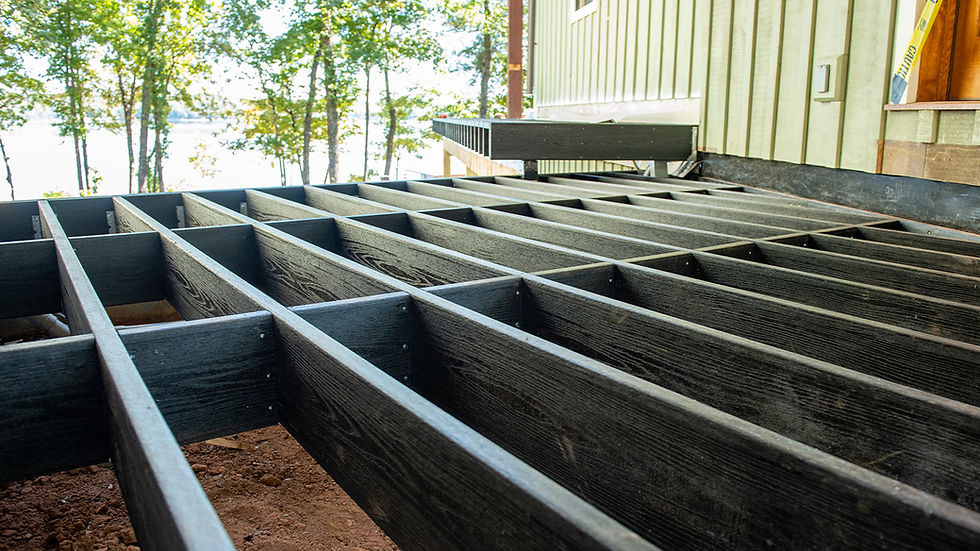
Why Framing Lumber Matters More Than Most People Think
When homeowners picture a new deck, they think about what they’ll see.
Deck boards. Railing. Color.
What they don’t see is what holds everything up.
Framing is the structure of the deck. If it moves, twists, or breaks down over time, it doesn’t matter how good the surface looks.
That’s why the type of lumber used underneath matters just as much as what’s on top.
What Pressure Treated Lumber Actually Is
Traditional pressure treated lumber is the most common framing material.
It’s infused with preservatives to protect against rot and insects, which makes it suitable for outdoor use.
But it has one characteristic that affects performance.
It’s wet when it’s installed.
That moisture content means boards can:
Shrink as they dry
Warp or twist
Move over time
That movement is where many long-term issues begin, especially under composite decking where consistency matters.

What KDAT Lumber Does Differently
KDAT stands for kiln dried after treatment.
It starts as pressure treated lumber, but then goes through a drying process that removes excess moisture before it ever reaches the job site.
That changes how the boards behave.
KDAT is:
More stable
Less prone to warping
Straighter during installation
For deck framing, that stability matters.
When your framing stays consistent, your decking surface performs better and looks better long term.

Where Owens Corning Lumber Fits In
Owens Corning lumber takes things a step further.
It’s treated and manufactured with consistency in mind, with a focus on dimensional stability and long-term performance.
One of the biggest differences is how uniform the boards are.
Less variation
Cleaner installs
More predictable results
For builders, that means less time fighting material and more time building something that stays true over time.
Why Stability Matters Under Composite Decking

Composite decking doesn’t behave the same way wood does.
It doesn’t shrink and expand the same way, which means it relies on a stable frame underneath.
If the framing moves, the surface shows it.
You may see:
Uneven lines
Fastener issues
Visible inconsistencies over time
That’s why we focus so much on what’s underneath.
The goal is to build a structure that stays consistent, not one that needs to settle into place.
What We Use and Why
At Deckmasters, we don’t treat framing as an afterthought.
We use KDAT and Owens Corning lumber because they give us more control over the final result.
We’ve built with standard pressure treated lumber. We’ve seen how it behaves.
The difference comes down to long-term performance.
The Trade-Offs to Understand
There is a reason traditional pressure treated lumber is still widely used.
It’s less expensive upfront.
KDAT and Owens Corning lumber typically come at a higher initial cost.
But what you gain is stability.
Less movement
Better long-term appearance
Fewer issues showing up later
It’s a trade-off between short-term savings and long-term performance.
A Real Example
We’ve seen decks framed with standard treated lumber where, over time, boards begin to twist and shrink.
The surface still looks good from a distance, but when you look closer, the lines aren’t as clean. Gaps change. Fasteners don’t sit the same.
On projects built with KDAT or Owens Corning lumber, that movement is much less noticeable.
The deck holds its shape.
That consistency is what homeowners notice after a few seasons.
Bringing It Back to Your Project
If you’re planning a deck, it’s easy to focus on what you’ll see.
But it’s worth asking what’s underneath.
What type of framing lumber is being used?
How will it behave over time?
Will it support the look you’re trying to achieve?
Those answers matter more than most people realize.
Seeing the Difference in Person
Framing may not be the most visible part of the project, but it’s one of the most important.
If you want to understand the difference between pressure treated, KDAT, and Owens Corning lumber, seeing and handling the materials in person helps.
It gives you a better sense of quality, consistency, and what you’re actually building on.
Final Thought
A deck is only as good as its foundation.
Choosing the right framing lumber is one of the decisions that determines how that deck performs years from now.


Comments