

Can Composite Decking Get Too Hot? What Homeowners Should Know
Trex SunComfort Trex SunComfort Trex SunComfort
The First Really Hot Day Tells You Everything
It usually happens in June.
You step outside barefoot for the first time in months. The grill is going. The kids are running around. Everything feels like summer again.
Then you step onto the deck.
And you feel it.
That quick moment where you realize the surface is warmer than you expected.
It is one of the most common questions we get.
Does composite decking get hot?
The honest answer is yes. But there is more to it than that.
All Decking Gets Hot in Direct Sun
This is the part most people do not hear clearly enough.
Every outdoor surface exposed to direct sunlight gets hot.
Concrete gets hot. Wood gets hot. Pavers get hot. Composite decking gets hot.
According to Trex, even boards designed with heat-reducing technology will still warm up on hot days when full sun and high temperatures come together.
So the goal is not to find something that stays cool in full sun.
The goal is to make smarter choices that reduce heat and improve comfort.
Color Makes a Bigger Difference Than Most People Think
One of the biggest factors in deck temperature is color.
Lighter colors reflect more sunlight and typically stay cooler. Darker colors absorb more heat and will feel warmer underfoot.
This is true across almost every material, not just composite decking.
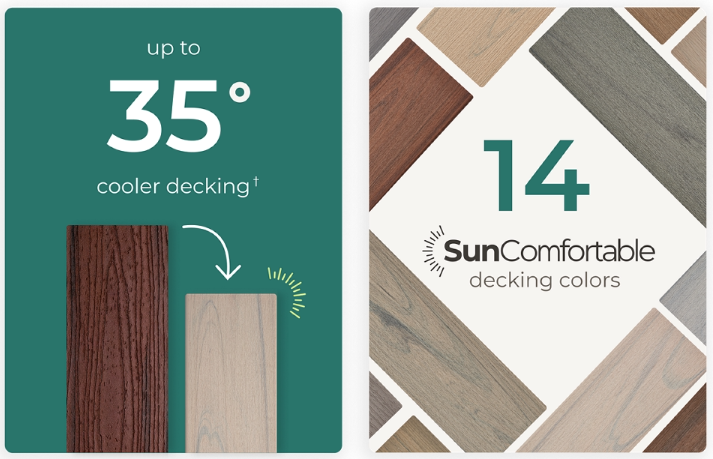
Trex has leaned into this with their SunComfortable lineup, where even darker tones are engineered to reduce heat compared to similar boards without that technology.
But the principle still holds.
If heat is a concern, lighter tones are always the safer choice.
What Trex SunComfortable Actually Does
Trex introduced SunComfortable technology to address one of the biggest concerns homeowners have.
Heat.
These boards are engineered to reflect more solar energy and reduce heat absorption compared to traditional composite decking.
In controlled testing, Trex has shown temperature reductions of up to 35 degrees compared to earlier boards, depending on color and conditions .
That is meaningful.
But it is important to understand what that means in real life.
It does not mean the deck stays cool on a 90-degree day in full sun.
It means it performs better than comparable materials and gives you a more comfortable surface overall.
Sun Exposure Matters Just as Much as Material
We have seen decks where heat is never an issue.
We have also seen decks where it comes up every summer.
The difference is usually not the material.
It is exposure.
A deck that sits in full sun all day will behave very differently than one with partial shade from the house, trees, or a pergola.
Even a few hours of shade in the afternoon can make a noticeable difference.
That is why we always talk about layout during design.
Where does the sun hit the deck at 2 p.m.?Where will people be sitting?Where will kids be playing barefoot?
Those answers matter just as much as the decking itself.
Airflow and Design Play a Role
Another factor people do not always consider is airflow.
Decks built low to the ground with limited air movement can hold heat longer.
Decks with better elevation and airflow underneath tend to cool down faster once the sun shifts.
It is a small detail, but over time it makes a difference in how the space feels.
Shade Changes Everything
If heat is a real concern, shade is the most effective solution.
This is where pergolas come into the conversation.
Adding overhead structure does not just change the look of the deck. It changes how it performs.
Shade reduces direct exposure.It keeps surfaces cooler longer.It makes the space usable during peak afternoon hours.
We see this all the time.
The same decking material can feel completely different depending on whether it is in full sun or partially shaded.
Setting the Right Expectations
The biggest mistake homeowners make is expecting any decking material to stay cool in full sun on a hot day.
That does not exist.
What does exist are better-performing options.
Trex SunComfortable is one of those.
It is designed to reduce heat compared to standard composite boards, especially when paired with lighter colors and thoughtful design.
But like any outdoor surface, it will still get warm in direct sun.
Understanding that upfront helps you make better decisions and avoid surprises later.
Bringing It Back to Your Deck
If you are planning a deck and heat is a concern, here is what matters most:
Color selectionSun exposureShade optionsAirflow and layout
Material matters, but it is only one part of the equation.
The best decks are designed with all of these factors in mind.
Seeing It in Person Makes a Difference
If you are trying to decide between colors or materials, it is worth seeing them in person.
Walking the showroom gives you a much better sense of how different tones look and how they might perform in your space.
We can also talk through layout, shade, and design options that help manage heat before the project even starts.
Because once summer hits, the goal is simple.
Be outside and enjoy it.
Not think about the surface under your feet.


Comments